The heart of modern data transmission.
Key Concepts:
- Modulation: ASK, FSK, PSK, QPSK, QAM (16-QAM, 64-QAM, 256-QAM), OFDM (used in LTE, 5G, Wi-Fi)
- Coding: Source coding, Channel coding, Error detection & correction (Parity, CRC, Hamming, Convolutional codes, Turbo & LDPC)
- Performance Metrics: Bit Error Rate (BER), Throughput, Latency, Spectral efficiency
Why It Matters: Essential for high-speed, reliable digital networks like 4G/5G.
Labs/Practice: Simulated QAM modulation and error correction; analyzed BER curves.
Tools Used: MATLAB, GNU Radio, NS3.
Lesson 3: Digital Communications
This is the heart of modern telecommunications. Almost everything in 4G, 5G, Wi-Fi, satellite links, fiber high-speed links, and even deep-space comms boils down to digital communications principles.
Lesson 1 gave you math and signals; Lesson 2 gave you sampling/filtering/LTI systems. Now we take bits → turn them into waveforms (modulation), protect them against noise/errors (coding), send them over channels, and measure how well they survive.
Why Digital Communications Is “The Heart”
- All modern telecom is digital at baseband: bits rule.
- The channel is noisy, fading, dispersive → we must fight entropy with smart modulation + coding.
- Goal: Maximize throughput (bits/s) while keeping BER low, latency acceptable, and spectral efficiency high (bits/Hz).
- This directly determines why 5G can do 10 Gbps, why Starlink works in LEO, why Wi-Fi 6/7 pushes higher rates.
1. Modulation – Turning Bits into Waveforms
Modulation maps bit groups to changes in carrier signal (amplitude, phase, frequency).
Basic schemes (historical but still used in low-rate links)
- ASK (Amplitude Shift Keying): bits change amplitude → simple but noise-sensitive.
- FSK (Frequency Shift Keying): bits change frequency → robust to amplitude noise (used in Bluetooth classic).
- PSK (Phase Shift Keying): bits change phase → constant envelope, good for power amplifiers.
Advanced / Modern schemes
QPSK (Quadrature PSK)
- 4 symbols (2 bits/symbol).
- Phases: 45°, 135°, 225°, 315° (or ±45° offsets).
- Each symbol = one complex number in I-Q plane.
- Constant amplitude → efficient for non-linear amplifiers.
- Spectral efficiency: 2 bits/Hz (ideal).

QAM (Quadrature Amplitude Modulation)
Combines amplitude + phase.
- 16-QAM: 16 points (4 bits/symbol) → 4×4 grid in I-Q plane.
- 64-QAM: 64 points (6 bits/symbol) → used in good-channel conditions (LTE/5G downlink).
- 256-QAM: 8 bits/symbol → Wi-Fi 6/7, 5G in excellent SNR.
Higher order = more bits/Hz but needs higher SNR (points closer → more errors from noise).
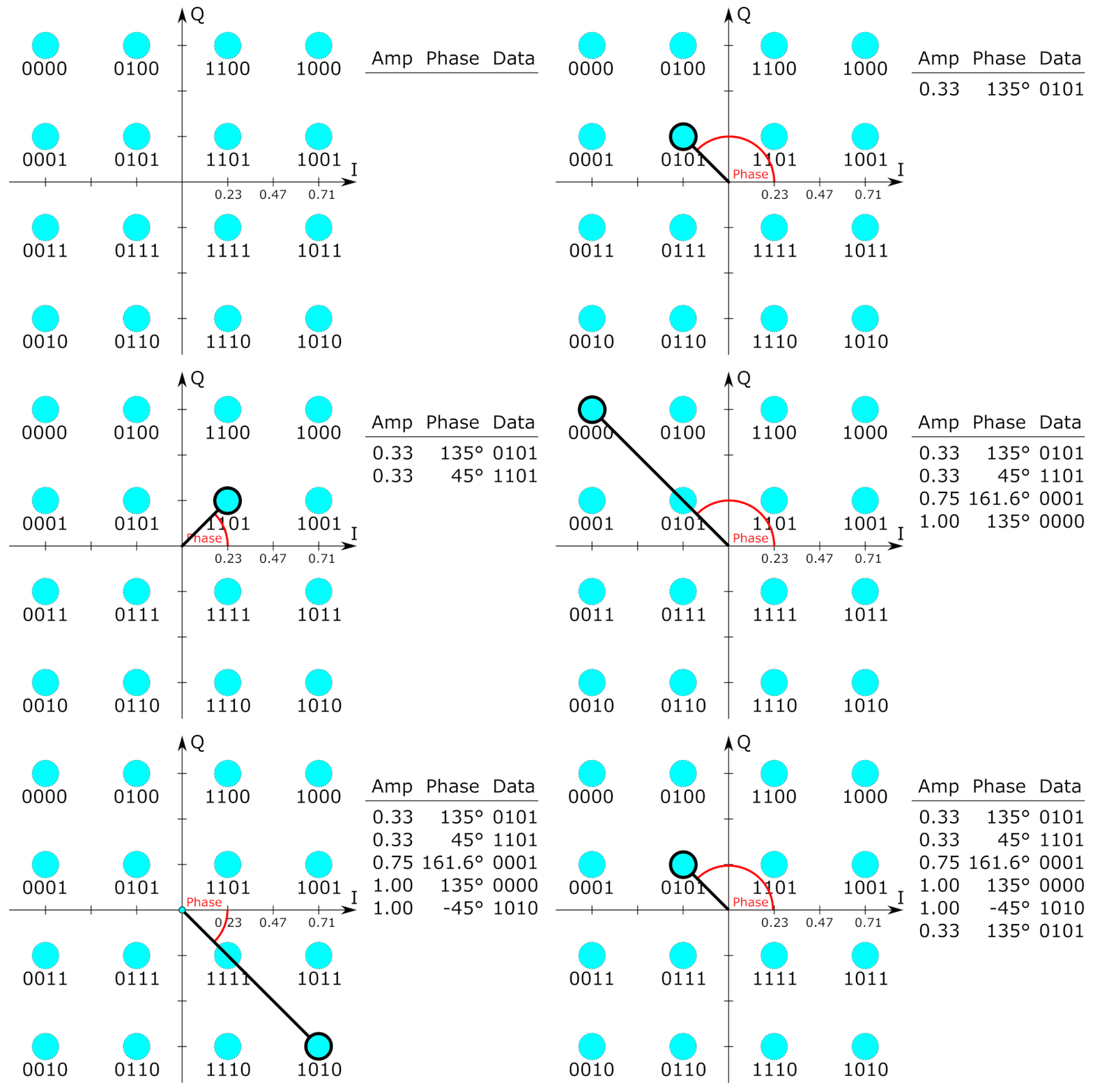
OFDM (Orthogonal Frequency Division Multiplexing) – The king of wideband digital comms
Used in: Wi-Fi (802.11a/g/n/ac/ax), LTE, 5G NR, DAB, DVB-T, power-line comms.
Idea: Split wideband carrier into hundreds/thousands of narrow orthogonal subcarriers.
Each subcarrier carries low-rate data (usually QAM-modulated).
Orthogonality → no interference between subcarriers (even though spectra overlap).
Key features:
- Cyclic Prefix (CP): Copies end of symbol to beginning → absorbs multipath delay spread → turns ISI into simple phase rotation (equalized per subcarrier).
- FFT/IFFT: Efficient implementation.
- Pilot subcarriers: Known symbols for channel estimation.
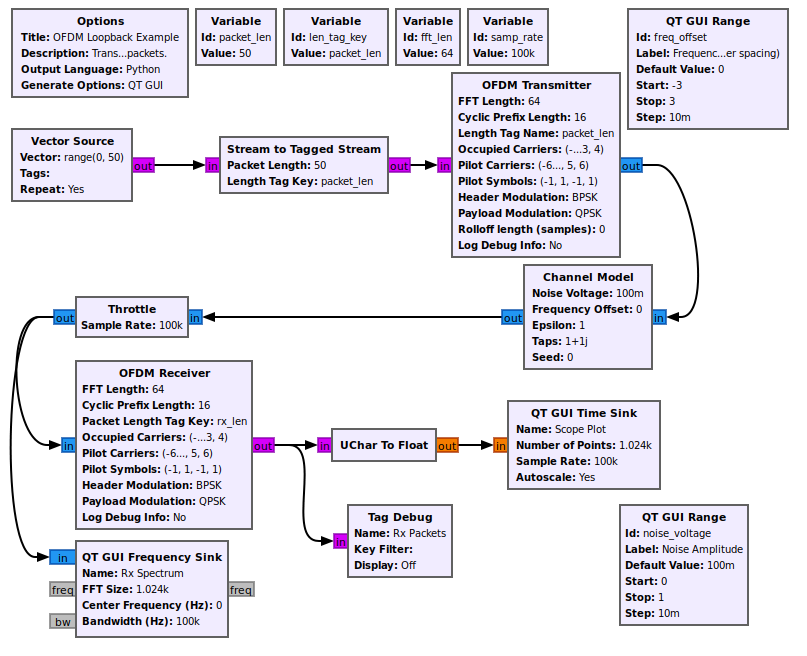
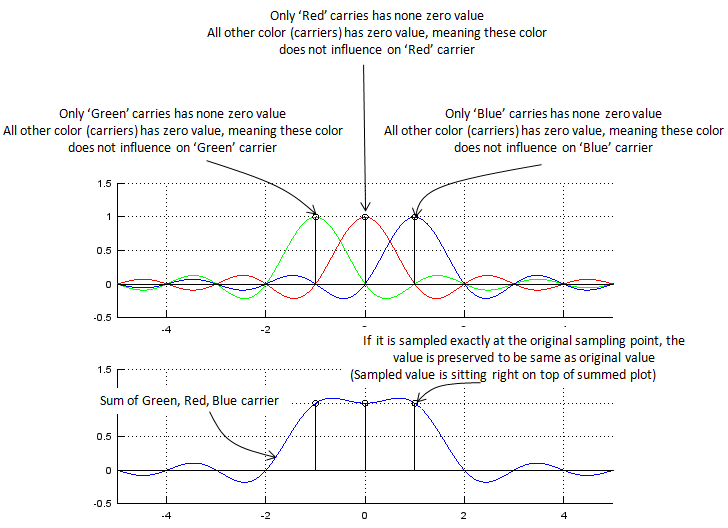
Why OFDM wins in mobile/wireless: Multipath fading is flat per subcarrier → simple one-tap equalizer per subcarrier.
2. Coding – Adding Intelligence to Fight Errors
Raw modulation is not enough — noise flips bits. Coding adds redundancy.
Error Detection (simple)
- Parity bit: Even/odd count → detects odd number of errors.
- CRC (Cyclic Redundancy Check): Polynomial division → very good detection (used in Ethernet, Wi-Fi, LTE/5G PDCP/RLC).
Error Correction
- Hamming code: Corrects single errors.
- Convolutional codes + Viterbi decoding → good for continuous streams (classic GSM, CDMA, early Wi-Fi).

- Turbo codes: Parallel concatenated convolutional codes + iterative decoding → approach Shannon limit (3G UMTS).
- LDPC (Low-Density Parity-Check): Sparse parity-check matrix → iterative belief propagation. Used in: 5G data channel, Wi-Fi 6/7, DVB-S2, 10GBASE-T. Very close to Shannon limit.

Modern trend: 5G uses LDPC for data, Polar codes for control channels.
3. Performance Metrics – How We Judge Success
- Bit Error Rate (BER): Probability a bit is wrong after decoding. Target: 10⁻⁵ to 10⁻¹² for data.
- Throughput: Effective bits/s after overhead/coding/retransmissions.
- Latency: End-to-end delay (important for URLLC in 5G).
- Spectral efficiency: bits/s/Hz — higher = better use of bandwidth (Shannon limit: log₂(1+SNR)).

Observe:
- QPSK robust (works at low SNR) but low efficiency.
- 64-QAM/256-QAM need high SNR but pack many bits/Hz.
- Coding shifts curves left (coding gain).
How to Study & Practice This Lesson
Resources:
- “Digital Communications” by Proakis
- “Fundamentals of Wireless Communication” by Tse & Viswanath (free PDF online)
- YouTube: “IIT Bombay Digital Communication” or “Wireless Future Blog” series
Hands-on (crucial):
- Python/MATLAB: Generate QPSK/16-QAM symbols, add AWGN, demodulate → plot constellation scatter.
- Compute BER vs SNR curve (Monte Carlo simulation).
- Simple OFDM: IFFT → add CP → FFT → recover.
Milestone Questions (Portfolio Showcase)
- Why does higher-order QAM need higher SNR?
- How does cyclic prefix fix multipath in OFDM?
- Sketch QPSK constellation and explain decision regions.
- Why LDPC/Turbo beat convolutional in modern systems?
- Interpret a BER waterfall: what does “coding gain” mean?
Master this → 4G/5G architectures, RF impairments, and security attacks will make sense.